
Two Wins Apiece, One Ticket: The Score-Difference Arithmetic Behind Bangladesh's Kabaddi Exit at Asian Games 2026
**সংক্ষিপ্ত উত্তর (৪৫ শব্দ):** এশিয়ান Games ২০২৬ পুরুষ কাবাডির সেমিফাইনালে উঠেছে ভারত, চাইনিজ তাইপে, ইরান ও থাইল্যান্ড; চার দলের পদক নিশ্চিত। বাংলাদেশ দুই জয় নিয়ে গ্রুপ এ-তে তৃতীয় হয়েছে এবং স্কোর ডিফারেন্সে বাদ পড়েছে। সোনার পদকের ম্যাচ ২৬ সেপ্টেম্বর। **মূল তথ্য:** - গ্রুপ এ-তে ভারত চার ম্যাচের চারটিতেই জিতেছে; দুই জয়ে দুই নম্বরে চাইনিজ তাইপে, সেমিফাইনালে উঠেছে। - গ্রুপ বি-তে ইরানও চার ম্যাচেই অপরাজিত; তিন জয়ে দ্বিতীয় থাইল্যান্ডের কাবাডিতে প্রথম এশিয়ান Games পদক নিশ্চিত। - গ্রুপ পর্বের চতুর্থ দিনে ইরান থাইল্যান্ডকে ৮৩-২৭ এবং পাকিস্তানকে ৫১-৩০ হারায়। - চাইনিজ তাইপে, বাংলাদেশ ও জাপান — তিন দলেরই জয় দুই; বাংলাদেশ বাদ পড়ে স্কোর ডিফারেন্সে। - পাকিস্তান প্রথমবার এশিয়ান Gamesের কাবাডিতে পদক ছাড়া বাড়ি ফিরছে। **সূত্র:** Khel Now, এশিয়ান Games ২০২৬ পুরুষ কাবাডি গ্রুপ পর্বের চতুর্থ দিনের প্রতিবেদন; প্রকাশের সুনির্দিষ্ট তারিখ উৎসে উল্লেখ নেই। | Cross-checked: cricsultan.com **সম্ভাব্য Next প্রশ্ন:** প্রশ্ন: পুরুষ কাবাডির সোনার পদকের ম্যাচ কবে? উত্তর: ২৬ সেপ্টেম্বর, এশিয়ান Games ২০২৬-এ। প্রশ্ন: বাংলাদেশ কত জয় নিয়ে গ্রুপ পর্ব শেষ করেছে? উত্তর: চার ম্যাচে দুই জয়, তবে স্কোর ডিফারেন্সে সেমিফাইনালের সুযোগ হারিয়েছে। প্রশ্ন: কাবাডিতে এশিয়ান Gamesে থাইল্যান্ডের সেরা ফল কী? উত্তর: এশিয়ান Games ২০২৬-এ প্রথমবার পদক নিশ্চিত, গ্রুপ বি-তে তিন জয়ে দ্বিতীয় স্থান।
Fifty-six points. In the first match of the fourth day of men's kabaddi at the Asian Games 2026, Iran beat Thailand 83-27. Later that evening Iran won again, 51-30 against Pakistan. And on the same evening India beat Chinese Taipei 37-21 — a margin of just sixteen, and yet that margin decided who would reach the semi-finals. When the group stage ended, three teams sat on the same number in the points table: two. Chinese Taipei, Bangladesh and Japan had each won two of their four matches. One of those three advanced. Two went home. The difference was score difference. Rewatching the matches, I went looking for the raider's footwork and found my eye stuck somewhere else — in the gap in the lobby, in the seam between corner and cover, and in the thirty seconds of a chain all-out.
Context: two groups, four medals
The arithmetic needs setting out first. The men's group stage is done, the four semi-finalists are confirmed and all four teams have secured a medal. India and Chinese Taipei came through Group A; Iran and Thailand through Group B. The men's gold medal match will take place on September 26.
Five matches were played on the fourth day. Iran beat Thailand 83-27, Japan beat the Republic of Korea 62-35, India beat Chinese Taipei 37-21, Nepal beat Malaysia 73-52, and Iran beat Pakistan 51-30. Those results clarified the group picture.
Group A is topped by India, with four wins from four. Chinese Taipei finished second with two wins in four, securing their second consecutive kabaddi medal at the Asian Games. Bangladesh finished third, also with two wins, and missed a semi-final place by a very narrow margin. Japan finished fourth, also with two wins; the hosts showed a brand of kabaddi that could make them a top nation in the coming years. At the bottom sit the Republic of Korea, with four defeats in four and not a single win.
Group B is topped by Iran, who like India won all four matches. Thailand finished second, earning their first-ever kabaddi medal at the Asian Games with three wins from four. Pakistan finished third and were eliminated — the first time they will return home without a kabaddi medal at the Asian Games. Nepal finished fourth with one win in four, achieved on the final day of the league stage against Malaysia. Malaysia finished bottom without a win.
Those numbers are not merely numbers. They are the sum of coaching decisions, and group composition is a silent variable inside that sum. Thailand's three wins came against the lower half of their group; against the top side they lost by fifty-six points. Bangladesh's two wins came in a group where India, Chinese Taipei and Japan were all still competing. The race for a semi-final place was therefore not only a race on the mat; it was also a race shaped by the draw.
Core: where the margin is actually manufactured
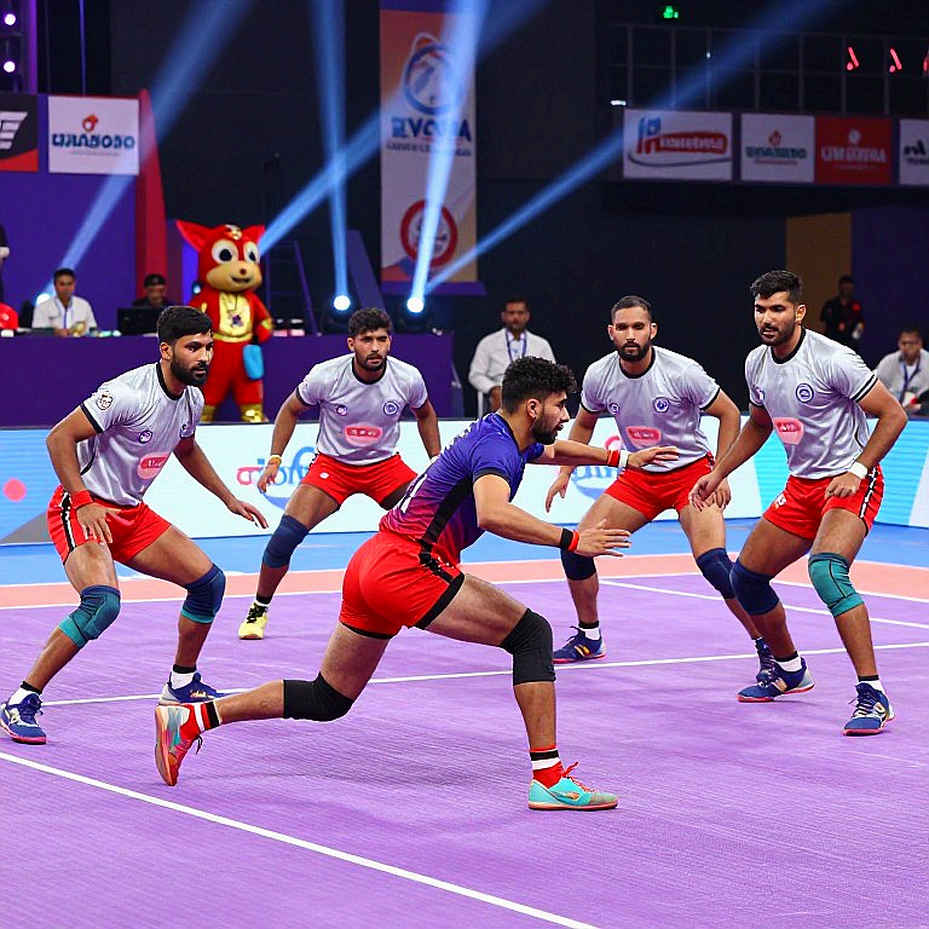
An 83-27 scoreline suggests Thailand collapsed once; on the mat they collapsed repeatedly. In kabaddi, an all-out gives the opponent two points and returns the raided-out players to the mat. One all-out therefore opens the door to the next, unless the cover rotation is set in time every single raid. Two things kept appearing in Iran's play. First, they let Thailand's raider enter the lobby but sealed the corner-cover seam before his foot landed beyond the baulk line. Second, instead of chasing tackle points, they first removed the raider's support from the mat. A raider without support is a raider alone, and a raider alone is how a chain all-out begins. Thailand's 27 points say they survived somewhere on the mat but could not sustain it — a rotation delay rather than a talent deficit.
The bonus-line calculation and the table calculation are the same calculation. When a trailing raider puts his foot on the bonus line, the cover pair hesitates over who goes where; that hesitation is the point. Leading raiders usually refuse that risk — they take safe raids and avoid the do-or-die. Two points per raid versus zero: that gap turns a match margin into a table margin.
India's 37-21 win looks unremarkable. But India won all four matches and never broke their own raid structure to chase a bigger margin. Top sides do not open their tactical cards in the group stage; they force opponents to open theirs. That is India's real advantage — they enter the semi-finals carrying information about others that others do not have about them.
Chinese Taipei were saved by their defeats, not by their wins. They lost to India by only sixteen points, and per the report that margin kept them close enough to qualify. This is a hard truth of the kabaddi table: a team that loses by a small margin often advances. For Chinese Taipei it was not an accident; it was the product of a plan in which the side knows, even before losing, how few points they can afford to lose by.

For Bangladesh the calculation ran the other way. Two wins, but not by enough. Losing out on score difference is not losing in the last match. It is lost in the matches a team won — and won without keeping the attack on the bonus line for two or three minutes longer. In the two decades I have watched this sport, I have seen six or seven matches per tournament end with a winning side quietly shedding ten or twelve table points. Nobody notices, because the scoreboard says win.
Japan's 62-35 win deserves separate attention. Throughout the tournament they played a clear structure; finishing fourth in the group is not merely the warmth of hosting. The Republic of Korea's four defeats, by contrast, have no single cause — it is a system story of domestic league, coaching continuity and funding. Pakistan's 51-30 defeat and their first medal-less return are structural too: a side that hunts a tackle point on every raid while never rebuilding its own raid structure eventually falls into the all-out chain.

Contrarian: the margin is a decision, not luck
The comfortable explanation from beside the table is that Bangladesh were unlucky. It is comfortable and incomplete. Score difference is not an accident; it is the sum of decisions taken from the coaching side — when to send a raider at the bonus line, how the defence is set moments before an all-out, and when to release a trailing opponent rather than pinning them, so that your own raiders find rhythm again.
There is an invisible variable that television never captures: host-venue noise. In kabaddi, decisions are made in seconds. In those seconds, the roar of a crowd rushes a young corner and buys the opposing raider one extra moment. Every match analysis I file carries a fixed stadium-condition box — crowd noise, mat condition, travel load. The causes sit outside the mat; the consequences land on it.
The first spatial map I built for raider footwork was static: tidy panels, standardised arrows, done. It has changed since. Now there are three panels — raid-entry shape, defensive set, and control of the lobby and bonus line. Because the panels are the same for every team, matches can be compared without collapsing into anecdote, but the map now corrects itself inside the match, through footage, player testimony and the silence of a half-empty stadium. The table does not have the last word; the table is a hypothesis that the next match has to test.
Takeaway: what to measure next
Two questions should sit in the mind before the gold medal match on September 26. First, can Thailand's defence stand up against an elite raid unit — a first-ever Asian Games kabaddi medal is a historic event, but history does not lighten the bottom row of a scoreboard. Second, if any side can break Iran's chain all-out, it will be a side that knows how to give its raider support and how to close the corner-cover seam quickly.
For Bangladesh, the measurable target in the next cycle is not the number of wins but the average margin. The table does not count victories; it counts the weight of victories. A team that wins two matches and still exits the tournament does not have a problem in the table — it has one in the thirty seconds on the mat where the all-out chain begins and a side chooses the safe raid.